
The real reason your DIY automations keep breaking
Zapier usually gets the blame, but the real causes sit elsewhere. A look at why weekend-built automations fall over, when DIY is genuinely the right call, and when it is time to get help.
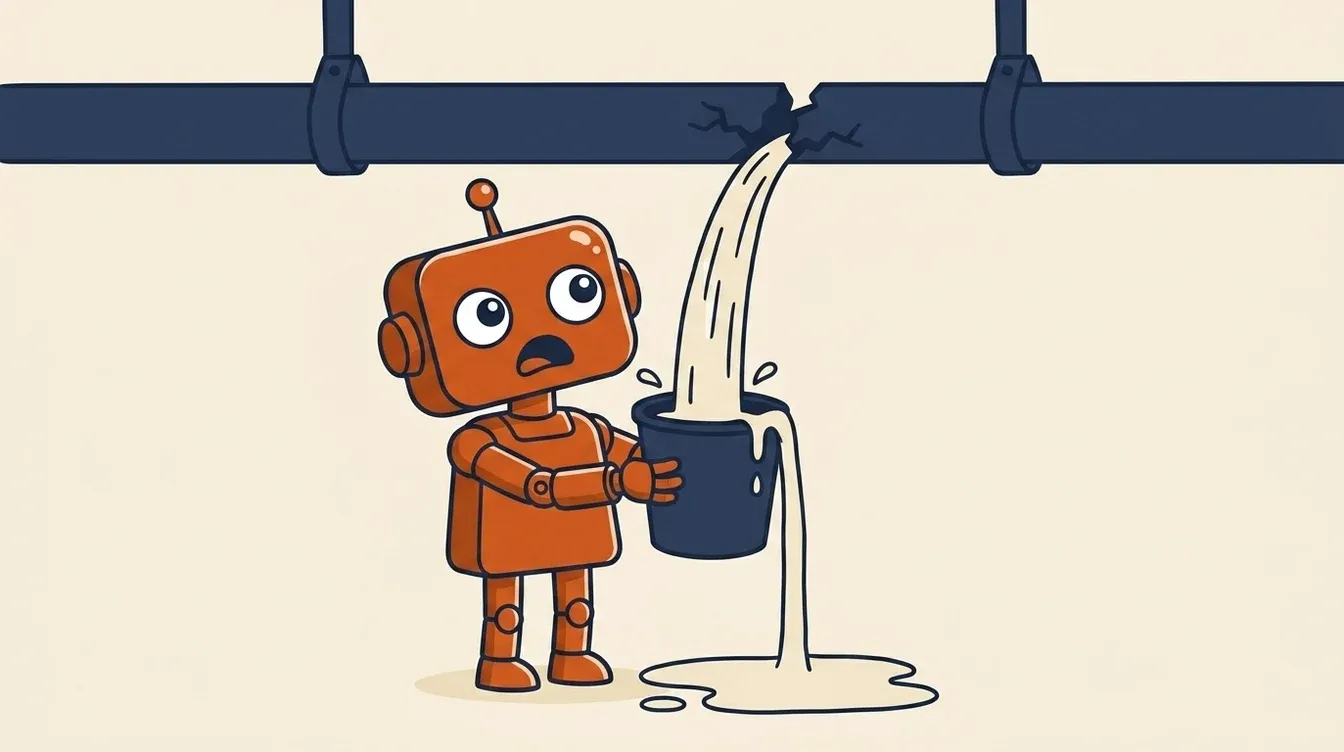
The pattern is so common it is almost a rite of passage. A few late nights with Zapier or Make, a working automation by Sunday, a small feeling of triumph, and then three weeks later a customer mentions they never got a confirmation, and you discover the thing silently stopped running on the 14th. You fix it. A month later it breaks differently.
Your automations keep breaking because they were built on the happy path: the version of the process where every input is clean, every app behaves, and nothing unusual happens. Real businesses do not run on the happy path. That is the whole answer, and the rest of this article is what to do about it, including an honest look at when you should keep doing it yourself.
It is not the tools
Zapier, Make and n8n are good software. We use Make and n8n in client builds ourselves. When an agency person tells you the tools are toys and you need their proprietary platform, hold onto your wallet, because platform lock-in is a worse problem than any broken zap.
The gap is not the tool. It is three things the tutorials never mention.
The three gaps that actually break your automations
- The happy-path gap. Your weekend build handles the enquiry that arrives as expected. It does not handle the form submitted twice, the email with the question in the subject line, the customer who replies to the wrong thread, or the lead with an emoji in their name that breaks a filter. Handling the mess is most of the work, and the tutorials skip it because the mess is different in every business.
- The silent-failure gap. When your automation breaks, what happens? In most DIY builds the answer is "nothing tells anyone". A professional build fails loudly: an error lands in front of a person, and the lead or invoice it was carrying does not evaporate. Error handling is boring, invisible when it works, and the single biggest difference between a build that lasts and a weekend project.
- The nobody-owns-it gap. Apps update their interfaces, your process drifts, a password changes, and the automation quietly stops matching reality. If keeping it alive is nobody's actual job, entropy wins every time. This is a maintenance problem, not a skill problem, and it exists whether you or an agency did the building.
When DIY is genuinely the right call
Plenty of situations do not deserve a consultant, and pretending otherwise would be the exact salesmanship this blog exists to avoid. Build it yourself when:
- The stakes are low. If it breaks for a week and nobody outside the business notices, it is a fine DIY candidate. A Slack alert when a form is submitted. A spreadsheet row for each sale.
- It is one trigger, one action. Short chains barely break, and when they do the fix is obvious.
- You actually enjoy it. Some owners genuinely like this work, and the skills compound. If that is you, build the low-stakes automations yourself forever, and you will also be a far better client for the complex ones.
The line to watch is not complexity, it is consequence. The moment an automation touches a customer, carries a lead, or moves money, a silent failure starts costing you real business, and the three gaps above stop being theoretical.
When it is time to get help, and what to insist on
Get help when the automation is customer-facing, when it spans several systems, or when you have rebuilt the same zap three times and it still surprises you. But how you buy the help matters more than whether you do, because the standard agency model replaces your maintenance problem with a dependency problem: they build it in their accounts, undocumented, and every change costs a phone call and an invoice.
Whatever you insist on, insist on these:
- It gets built in your accounts, on your logins, so nothing goes dark if the relationship ends.
- It fails loudly, with errors routed to a person, and the person is on your team.
- It is documented in plain language, and someone on your side is taught how it works and how to change it.
- No forever retainer is required just to keep your own system running.
That list is, not coincidentally, how we build. It is also a fair vetting checklist for anyone else you might hire; the longer version is in the ten questions to ask before hiring an AI automation agency.
Moving from DIY without throwing your work away
If you already have a tangle of zaps half-working, you do not need to rip anything out. The sane path is a map first: list what exists, what each piece carries, and which failures would hurt. Keep the low-stakes ones exactly as they are. Rebuild the consequential ones properly, one at a time, starting with whichever touches customers. Your DIY work is not wasted; it is the process documentation most businesses never have, and it makes the rebuild faster. A workflow audit is designed to produce exactly that map in 30 minutes.
Common questions
Why do my Zapier automations keep breaking?
Usually one of three reasons: the automation only handles clean, expected inputs; failures are silent so small breaks become long outages; or connected apps changed and nobody owns keeping the automation in step. The fix is error handling and ownership, not necessarily a different tool.
Is Zapier enough for a small business?
For low-stakes, single-step automations, absolutely, and it may be all you ever need. The ceiling is not the tool's features, it is the design around it: multi-step flows that touch customers need error handling, escalation rules and maintenance that off-the-shelf recipes do not include, whichever platform runs them.
Should I hire an automation agency or do it myself?
Decide by consequence, not complexity. If a week of silent failure costs you nothing, DIY. If the automation carries leads, quotes, invoices or anything a customer sees, have it built properly, in your own accounts, documented, with your team trained to run it. And be as wary of agencies that create dependency as you are of your own weekend builds.
What does hiring help actually cost?
A properly scoped build is a one-off project with a clear number attached, plus modest tool subscriptions you would be paying anyway. What it should not be is an open-ended retainer you cannot leave. We've published the real figures, ranges included, in what AI automation actually costs a small business. You should have the number before you decide anything; a free workflow audit gets you one in 30 minutes, whether or not you use us.
Find out which of your automations are worth rebuilding
Book the free 30-minute workflow audit and bring your zaps, the working ones and the haunted ones. You leave with a map of what to keep, what to rebuild first, and a clear number for the rebuild, whatever you decide to do next.
Book the free workflow audit Not ready to talk? Take the free two-minute scorecard →