
10 questions to ask before you hire an AI automation agency
And the wrong answers to listen for. I run one of these agencies, so read this knowing that. These are the questions I would ask before hiring anyone, including me.
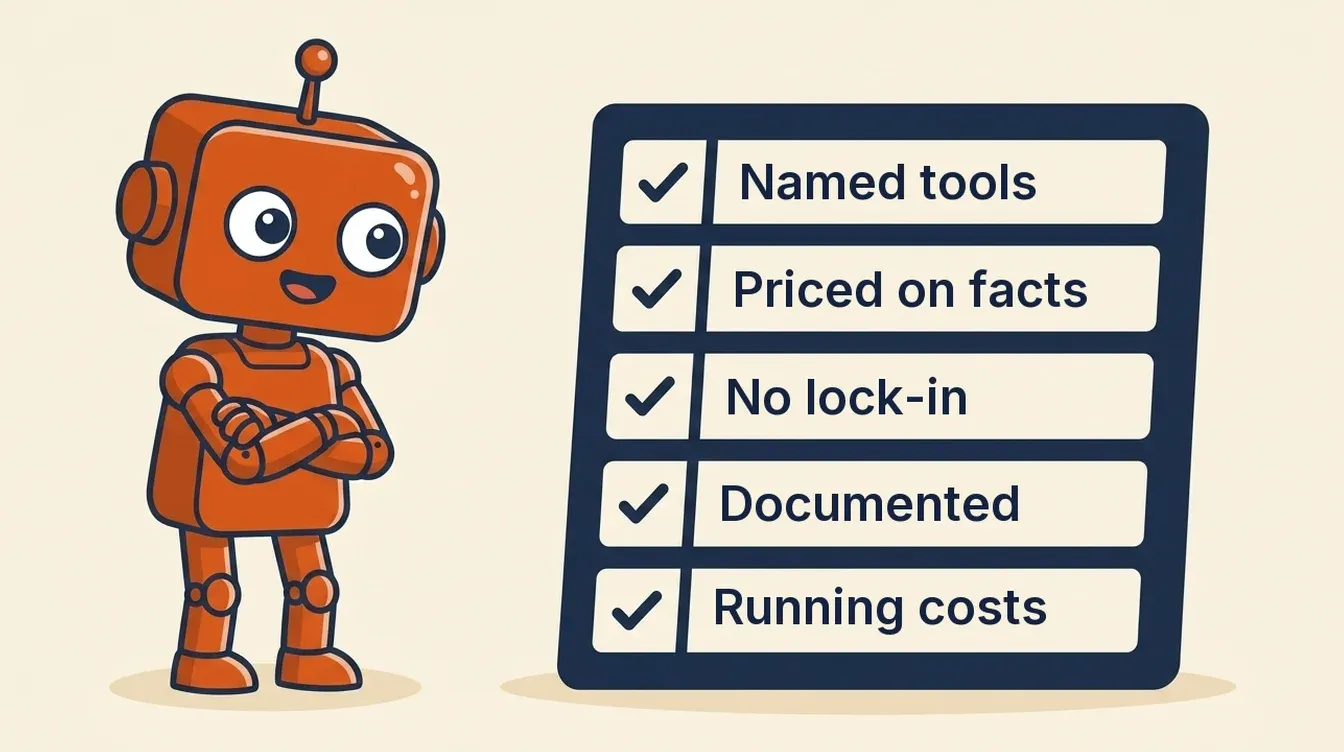
A friend of mine paid five figures for an AI transformation. He got a slick demo, a document full of recommendations, and a chatbot that stopped working around the time the agency stopped replying to him. Nothing about his story is unusual. There are good builders in this space. There are also plenty of people selling decks, and a growing number building systems their clients can never leave.
So here is how to vet an AI automation agency before you sign anything. Ten questions, and for each one, the answer you want to hear and the answer that should worry you. The worrying answers are strangely consistent across the industry, which makes them useful: once you know the phrases, you can hear them coming.
One honest check before the questions, though.
First, check you actually need an agency
A surprising amount of automation in 2026 is a subscription, and no longer a project. If your problem lives inside one tool, like appointment reminders in your booking system or invoice chasing in your accounting software, the software you already pay for can probably do it. Turn the feature on and keep your money. The US Small Business Administration's plain-English AI guide is a decent neutral starting point.
You need outside help when the work crosses several systems that have to stay in sync, needs judgement calls built in, or has to be reliable enough that nobody babysits it. If you are not sure which side you are on, our free two-minute scorecard will tell you where AI would help your business first and whether the task is even ready. No call required.
If you do need an agency, ask these.
1. "Can you show me one system you built, and the number it moved?"
Every agency website has a wall of logos and a testimonial saying the team was lovely to work with. Neither tells you whether they can build. One specific system does: the business it was for, the job it did, and the number it moved.
One concrete story with a before and after. Something like: a broker was answering leads in a few hours, we built a reply flow around his own templates, now it is a few minutes, and he runs it himself. Business type plus numbers is the minimum. Then ask for a reference you can actually call.
"We've helped dozens of businesses transform their operations." Dozens, and yet not one they can describe? If they were genuinely measuring their results, they could name one build without thinking about it.
2. "Where will it be built: my accounts or yours?"
This one sounds like a technical detail, but it decides who holds the power once the project ends.
In your accounts from day one. Your CRM, your inbox, the automation tool under your own login. If the agency disappeared tomorrow, everything keeps running.
"We host everything on our platform to keep things simple for you." Simple for them. If the system lives in their accounts, the day you stop paying is the day your operations go dark, and they know it.
3. "When it's finished and paid for, who owns it? All of it?"
Ownership is the question most buyers remember to ask, so agencies have learned to say yes to it. The useful information is in the follow-ups. Does "all of it" include the workflows, the prompts, the documentation? Is it in the contract?
"You do, all of it," in writing, with nothing carved out.
"That's our IP." Also watch for the half-yes, where you own the results while they own the machine that produces them. If ownership exists in the sales call and never makes it into the contract, it doesn't exist.
4. "Will I understand it well enough to change it without you?"
This is the question I almost never hear buyers ask, and it matters more than ownership. Plenty of agencies will now put "you own it" on paper. Far fewer will build in a way that leaves you understanding the thing you own. Owning a system you can't open is like owning a house where only the previous owner knows where the pipes run.
A real plan for transferring understanding: you involved while it is built, documentation in plain language, your team trained to run it and tweak it. You should be able to change a message template or a rule yourself, without booking a call.
"Don't worry, you won't have to touch a thing." It sounds like good service. In practice it means every small change, for as long as you run the system, turns into a phone call to them and an invoice from them.
5. "What tools will you build on? Name them."
A dozen or so tools sit behind most small business automation, and none of them are secret.
Real names and plain reasons. Make or n8n for the plumbing, your existing CRM, your existing inbox. Naming the tools costs them nothing, unless the vagueness was the product.
"We use our proprietary cutting-edge AI stack." That usually means one of two things: an ordinary tool with a markup on it, or lock-in by design. Either way, you just learned something.
6. "What do you need to learn about my business before you can quote?"
A fair price for a job nobody has scoped is a coincidence.
Questions coming back at you before any numbers do. Where does time leak, who does this job today, which tools does it cross, what happens when it goes wrong. A good agency cannot price your job on the first call, and a good one says so.
A confident quote in the first twenty minutes. You are not being scoped, you are being fitted to a template. Templates are fine when they fit, but at that point nobody has checked whether this one does.
7. "What will it cost to keep running after you leave?"
The build price gets all the attention, but the monthly costs are where dependency tends to hide.
An honest breakdown: the tool subscriptions, in your name, which usually run to tens of dollars a month rather than hundreds; any AI usage costs; and support that is genuinely optional.
A mandatory monthly retainer to "keep your system running." Ask what specifically it covers. A retainer you cannot decline without your own system going dark is rent by another name.
8. "What happens when it breaks?"
Everything breaks eventually. An app updates, a form changes, an edge case walks in the door. The difference between agencies is whether they find out before you do.
Monitoring that alerts them when something fails, documentation good enough that someone else could fix it, a clear support window included in the price, and honest rates after it ends.
"Our systems don't break." Or support that only exists inside the retainer from question seven. Ask them to describe the last thing that broke and how they caught it, and pay attention to how quickly the specifics arrive.
9. "How much of my time will you need, and what for?"
Both extremes should worry you here. When an agency needs none of your time, the system gets built on guesses about how your business actually works. The opposite extreme is no better, because a month of billed workshops usually means you are paying them to learn on the job.
A small number of focused sessions, each with a clear job: map the bottleneck, shape the workflow, test it on real work. The building happens between sessions, on their time.
"You won't need to be involved at all." That is how you end up at question four owning a system you don't understand. A few hours spread across a few weeks is reasonable. Zero hours means it was built around guesses.
10. "Tell me about a build that didn't work. What happened?"
Anyone who has built enough systems has one that underperformed. This question tests honesty, and it is the cheapest test on the list.
A real story with a cause and a change. "We automated a quoting flow before the pricing rules were written down anywhere, it kept producing quotes a human had to fix, and now we check for that in discovery." An answer like that should make you more confident, because it means their process has scars in it.
A blank stare, a claimed hundred percent success rate, or a story where every cause was the client. "Their data was a mess" describes a real problem, and finding it before the build is exactly what discovery is for.
Five lines that should end the meeting
Some answers deserve a follow-up question. These five deserve your coat.
| If you hear this | It usually means this |
|---|---|
| "That's our IP." | The thing that runs your business will never be yours. |
| "We use proprietary cutting-edge AI." | An off-the-shelf tool they won't name, or lock-in by design. |
| "You could be live by Friday." | Nothing will be tested on your real work before it touches your real customers. |
| "You won't need to be involved at all." | Every future change to your own operations will go through their inbox, at their rates. |
| "Clients typically see 10x ROI." | A number invented for the sales call. Ask for one named example and watch what happens. |
The ten questions, in one list
Copy these into your notes and take them to the meeting.
- Can you show me one system you built, and the number it moved?
- Where will it be built: my accounts or yours?
- When it's finished and paid for, who owns it? All of it?
- Will I understand it well enough to change it without you?
- What tools will you build on? Name them.
- What do you need to learn about my business before you can quote?
- What will it cost to keep running after you leave?
- What happens when it breaks?
- How much of my time will you need, and what for?
- Tell me about a build that didn't work. What happened?
Common questions
How do I know if an AI automation agency is legit?
The same way you would check a builder: with specifics. Ask for one named, checkable result and a reference you can call. Ask what the system is built on and who owns it afterwards, and get the answer in writing. A legitimate agency survives specific questions, which is what the ten above really are. If every answer stays vague, you have your answer.
How much does an AI automation agency cost?
Published prices vary a lot. A focused first build usually runs from a couple of thousand dollars to the low five figures, depending on how many systems it touches. Ongoing retainers at bigger shops are commonly $2,000 to $7,000 a month. Two things matter more than the sticker: whether the quote comes after real discovery (question six), and whether any monthly fee is optional (question seven). The tools themselves are usually cheap, often under a hundred dollars a month. The full breakdown, including when a retainer is and is not worth it, is in our guide to what AI automation actually costs a small business.
Should I build it myself instead?
Sometimes, yes. If the job lives in one tool, follows simple rules, and you have the time, a Zapier or Make subscription may be all you need. DIY gets expensive when the work spans several systems and nobody owns the maintenance, which is how most self-built automations quietly die. The free scorecard takes two minutes and will tell you whether your task is ready and how big the problem actually is.
What are the biggest red flags when hiring an AI automation agency?
The recurring ones: no named results, everything hosted in the agency's accounts, "that's our IP," a quote before any discovery, a monthly retainer you cannot decline, and promised revenue multiples. Any one of them deserves a follow-up question. Two or more, walk.
Bring this list to a working session
Good agencies survive specific questions, and that is really all this list is doing. Ask all ten and the field thins out fast, and whoever is left standing is probably worth talking to.
If you want to see how I answer them: the system gets built in your own accounts, with you in the room, documented, and no-lock-in goes in writing. Book a free 30-minute workflow audit and bring this list. It is a working session, and question ten is fair game. If you want to know what else is worth bringing, there is a short guide on preparing for the call too.
Book a free workflow audit Not ready to talk? Take the free two-minute scorecard →